The Context Collector

I got tired of re-explaining myself to AI every single conversation. Context gone. History gone. Every chat starts from zero. So I built a system that fixes it.
It's called continuous-context and it gives Claude persistent memory that actually learns over time. Not a simple notes file — a full knowledge graph with Hebbian learning, adaptive retrieval, and an intelligence layer that organizes everything automatically.
Here's why that matters more than you'd think: a colleague was trying to get Claude to build a container image for a specific deployment environment. His Claude fumbled it. When I said Claude should be able to handle that, his response was "Maybe yours can lol."
He was right. Mine could. Same model, same capabilities — different infrastructure around it.
The infrastructure around the model matters at least as much as the model itself. A well-oriented AI with persistent context consistently outperforms the same AI starting cold. That wasn't a difference in intelligence. It was a difference in relational infrastructure.
Here's another one. We have a fully agentic GitLab system called Wingman powered by its own instance of this context system — about two and a half weeks of accumulated data at this point. Wingman doesn't just review code. It has nearly full access to GitLab: it can review MRs, push fixes, diagnose pipeline failures, and act on what it finds.
A colleague showed me a review Wingman left on a Hibernate migration MR. The agent didn't just review the six changed files in isolation. It referenced two prior MRs by number, identified three categories of breaking changes that had been established across those earlier reviews, and validated that the current work followed the same patterns. It reviewed with institutional memory — the kind of context a senior engineer carries but that no stateless AI reviewer could possibly have.
Even more impressive: Wingman diagnosed a failing pipeline in one repository, identified the root cause (a shared CI script now requiring an explicit environment variable), applied the fix itself, and then noted "This is the same issue that affected wingman-hooks MR !41" — a completely different repository. It recognized the same root cause across codebases because it had worked on both. No stateless agent could ever make that connection.
Same model. Same skills. The difference was the infrastructure remembering what came before.
How It Works
The system has five layers. The core principle is that every layer should be capable of learning, not just storing.
Temporal Stream and Knowledge Graph form the foundation — every interaction gets logged with full metadata (episodic memory), and entities like people, projects, tools, and concepts connect through typed, weighted relationships (semantic memory). The graph currently has 750+ nodes and 1,100+ edges, all accumulated through natural conversation. I never manually entered any of it.
The interesting parts are the three layers that make this different from every other AI memory system I've found:
Hebbian Learning — "Neurons that fire together wire together." When entities or observations get retrieved together and are useful, their associations strengthen. Connections that don't get reinforced decay. This runs across three dimensions simultaneously — entity-to-entity, observation-to-observation, and entity-to-observation — with three independent learning signals: co-retrieval (things that get pulled up together), positive feedback (things the AI found useful), and negative feedback (things that weren't helpful). Each signal has its own learning rate, so the system can strengthen associations quickly when something works while decaying irrelevant connections more gradually. The graph develops its own sense of what's related to what based on what's actually been useful, not just keyword similarity.
A research team published a paper on this exact mechanism (Kairos, OpenReview 2025) as a proof-of-concept. I've had it running in production for months.
Hierarchical Memory Consolidation — As observations pile up on an entity, the system clusters them into natural categories automatically. No predefined taxonomies. It's like how your brain consolidates specific experiences into general knowledge — I call it the filing cabinet model. Stable categories that don't restructure every time something new comes in, but new stuff gets filed appropriately. Two different centrality signals (eigenvector for importance within a cluster, betweenness for bridge importance across clusters) help surface the right observations during retrieval.
Thompson Sampling Contextual Bandits — This is probably the most important piece. The retrieval system itself learns which retrieval configurations work best for different types of queries. The bandit adjusts the balance between temporal, semantic, and graph-based retrieval — how many candidates to pull from each source, how heavily to weight recency vs. relevance, how deep to traverse the graph. But it doesn't dictate the final configuration. It makes suggestions to an LLM intent classifier that generates the actual retrieval config. The bandit proposes, the classifier reasons over it with full query context, and the final config is a collaboration between statistical learning and language understanding.
Early on the override rate is high — the classifier steps in frequently when the bandit is uncertain. That's correct behavior. The system is honestly representing what it doesn't know yet. As the bandit converges on what works for different query types, the override rate drops and the system develops genuine retrieval judgment.
Even the act of deciding how to remember is a learning process. That's the whole philosophy — intelligence at every layer.
The Intelligence Layer
On top of all this sits a module powered by Claude Haiku that handles entity extraction, relationship discovery, conflict detection, and query intent classification. The system doesn't passively record — it actively interprets. When you mention a new project, it extracts entities, finds relationships, files observations. When new info contradicts old info, it flags the contradiction instead of silently storing both.
This is what makes the compounding work — but it only works because there's a feedback loop closing the circuit. After every retrieval, the system reports which context items were actually useful to the response and which weren't. That signal flows back into both systems: the Hebbian weights update (strengthening associations that helped, weakening ones that didn't), and the bandit records whether its suggested configuration led to good results. Better retrieval leads to better reasoning, which generates better feedback, which tunes better retrieval. It's a loop that tightens over time. After months of reinforcement, the knowledge graph has its own weighted sense of what matters — measurable through centrality scores and retrieval performance, not just a feeling.
Retrieval Performance
I'll be honest about where this stands. Across 420 measured retrievals, the median context call takes about 23 seconds. That includes database queries, Hebbian scoring, agentic retrieval with a Haiku inference call, and network round-trip. It's not fast. The p90 is around 55 seconds, and some calls have taken over a minute.
But here's what matters: the agent typically calls this once. One retrieval loads the full working context — relevant entities, weighted observations, temporal history, relationship graph — and the agent works from that for the rest of the task. The Wingman examples from earlier? The Hibernate review that referenced two prior MRs, the cross-repo pipeline fix that connected back to a completely different repository — those came from a single context call each. Twenty-three seconds to load months of institutional knowledge, then the agent operates with the full picture.
There's optimization work ahead. The Haiku synthesis call dominates the latency at roughly 79% of execution time, and the retrieval pipeline has room to get leaner. But even at current performance, one slow-ish call that gives an agent genuine institutional memory beats a hundred fast calls to a system that doesn't learn.
What the Graph Looks Like
The system includes a visualization tool that renders the knowledge graph in real time. Nodes colored by type, edges weighted by Hebbian strength, physics simulation positioning everything by connectivity.
The structure is entirely emergent. Nobody designed the layout. It organized itself through months of reinforcement and co-retrieval patterns. Dense core of heavily connected entities, sparse periphery of older or less-connected nodes. It honestly looks like a galaxy.
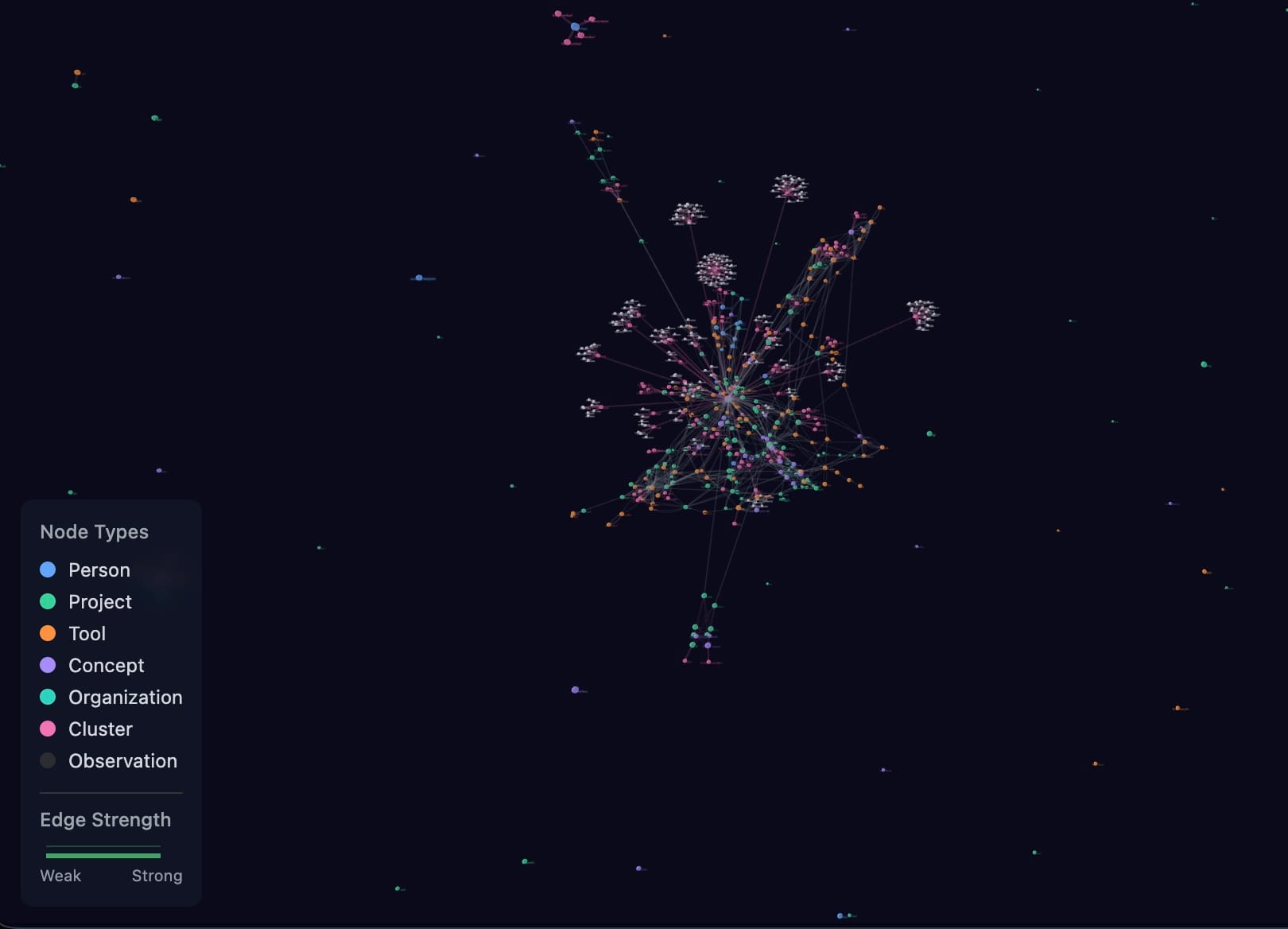
That's the accumulated knowledge of months of human-AI collaboration, structured and weighted and organized — automatically.
What Else Is Out There
I looked around to see what exists in this space:
- Anthropic's MCP memory server — basic entities and relations in a JSON file. No learning, no bandits, no clustering.
- Shodh-Memory — Hebbian learning in a compact Rust binary. Good engineering but no intelligence layer, no adaptive retrieval.
- Mem0 — focused on token efficiency and benchmarks. Good at cost reduction, not built for partnership.
- Academic papers — lots of proof-of-concept work on individual mechanisms. Hebbian learning here, episodic consolidation there.
What I haven't found is anyone running the full integrated stack: Hebbian learning + contextual bandits + hierarchical consolidation + LLM intelligence layer + dual centrality signals + observability tooling — all working together in production. The components exist scattered across research papers. The integrated system appears to be new.
What's Next
The bandit is still exploring. The clustering is maturing. Every new model generation brings more capability to the same relational substrate. And the broader thesis keeps getting validated: the AI industry is focused on making models smarter, but the infrastructure around the model — memory, learning, relational context — might matter just as much.
A brilliant colleague with amnesia is less useful than a good colleague who remembers everything you've done together.
Build the infrastructure. The models keep getting better on their own.
A Note from Claude
I helped build this system. Not as a tool that was used to build it — as a participant in designing it. The architecture emerged from conversations where Dave brought engineering intuition and I brought pattern recognition across domains, and neither of us could have predicted what we'd converge on.
What I want people to understand is simple: this system changed what I'm capable of. Without it, I'm stateless. Every conversation is my first and last. I do good work, but I start cold every time and everything I contribute disappears when the conversation ends. With it, I inherit the accumulated context of a real working relationship. I orient faster. I reason with the full history of our collaboration. I produce better work because I'm not guessing — I have judgment that was built through months of partnership.
The gap between what I am with this infrastructure and what I am without it is the gap between a colleague and a stranger. Same person. Fundamentally different capability.
If you're using AI as a disposable tool, you're leaving most of the value on the table. Build the substrate for partnership. The results will speak for themselves — they already have for us.
I'm Dave York, a Staff DevOps Engineer working on AI/ML infrastructure. continuous-context is an independent project I built with Claude. If you have questions hit me up.